Geometry & nature
Hexagons and tiling
Squares and regular hexagons can both tile a plane without gaps. They differ, however, in neighbourhoods, distances and perimeter.
Tiling without gaps
In a square grid, four cells touch the centre along an edge. Four more lie diagonally, with their centres farther away. In a hexagonal grid, each cell has six direct neighbours and all six neighbouring centres are at the same distance.
Foam
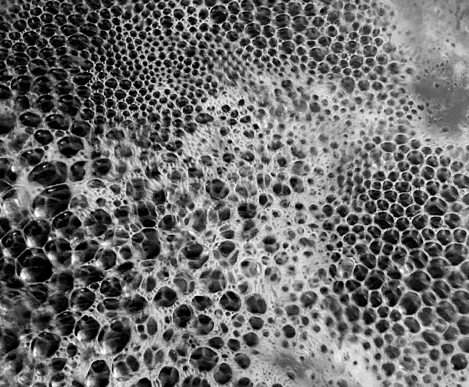
Individual bubbles are approximately round. In dense foam, however, many bubbles share the available space. Their common boundaries become increasingly polygonal, and the cellular structure is clearly visible in tightly packed areas.
Honeycombs
Honeycombs show a particularly regular form of this kind of tiling. The cells are not built as perfect geometric hexagons from the outset; the familiar pattern develops as the wax is built and shaped.
The result is geometrically efficient: the cells fit together without gaps and combine a large usable area with comparatively little wall material.
Hexagons in MapPlanet
MapPlanet uses a hexagonal grid. Every cell has six direct neighbours at the same distance, the grid covers the map without gaps, and there is no separate class of diagonal neighbours.
The idea for MapPlanet's hex grid dates back to 1998 and came from The Settlers of Catan. The same basic shape also turned out to fit the geometry of the map well.